One question every prospective website owner asks is, “How much will it cost me to build a website?” The truth is, there’s no fixed website prices. The cost of launching a website in South Africa, or any country for that matter, depends on several things, like design complexity, functionality, and hosting etc.
In this guide, we’ll break everything down to help you understand what you’re paying for, where you can save, and what to expect at each price level.
What factors affect website cost?
The total cost of a website depends on a few important choices you make along the way. Let’s start by looking at the main factors that determine how much you end up paying:
1. Type of website
A simple blog or personal portfolio would naturally cost less than an e-commerce store or a business website with advanced features. The more complex the site, the more time and effort it takes to build, which directly translates to a higher overall cost.
2. DIY vs professional development
If you build the site yourself, using say a website builder, you won’t incur any third-party development costs. That said, if you don’t have any design experience and want more control and flexibility, you should hire a web designer or developer. Of course, that would come at a higher cost.
3. Technologies used
The tools and platforms used to build your site matter too. A simple site built from a WordPress template, for example, would cost less than a custom-built site using frameworks like Next or Gatsby. Additionally, open-source tools can save money, while licensed software or premium plugins can add to the cost.
4. Features and functionality
The more you want your site to do, the more you’ll likely spend. Things like online payments, booking systems, user logins, or multilingual support all take extra time and development work.
5. Hosting
Your hosting plan plays a big role in cost. Self-managed hosting is usually cheaper, but it means you’ll have to handle updates, backups, performance optimization, and security yourself. On the other hand, managed hosting takes care of those tasks for you, but it comes at a higher price.
Also, if you expect a lot of traffic or want room to grow, you’ll need a scalable hosting option, which again, costs more.
6. Domain name
You’ll need a domain name (like myspecialweb.co.za). Local domains (.co.za) are generally affordable, but premium or brand-specific domains can cost much more.
Breakdown of website costs in South Africa
Next, let’s take a detailed look at the individual expenses you may incur while setting up your website:
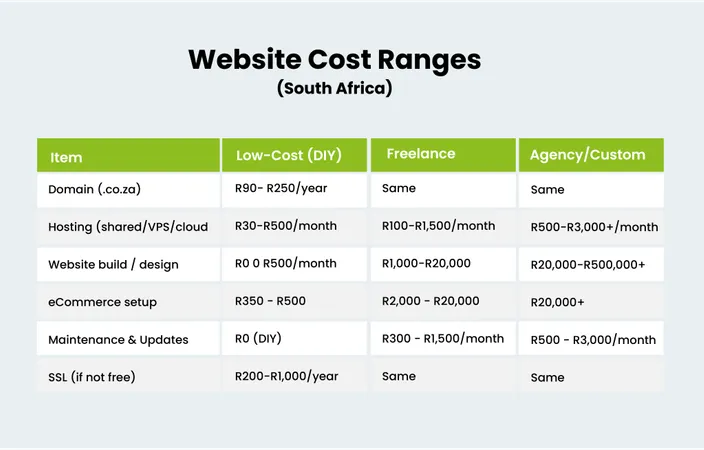
Domain name cost
Your domain name is your website address. The cost depends on the extension you choose (like .co.za, .com, or .org).
- A standard .co.za domain usually costs between R90 to R250 per year. HostAfrica, for example, offers .co.za domains at R99, which is quite competitive.
- Renewal fees range from R100 to R300 annually.
- Premium domains (short, catchy names or high-demand keywords) can cost a lot more.
- If you’re buying from a reseller, you will likely also pay a markup.
Web hosting cost
Web hosting is where your website lives. Different types of hosting come at different price points:
Shared hosting
- Cheapest option, where your site shares resources with other websites that are also hosted on the same server.
- Cost: R25 to R200/month.
- Good for small personal websites or blogs.
VPS (Virtual Private Server)
- Offers more control and resources than shared hosting.
- Cost: R100 to R500/month. Managed VPS can cost anywhere from R1500-3000.
- Suitable for medium-sized businesses or sites with moderate traffic.
Cloud hosting
- Scalable and reliable, ideal for high-traffic sites.
- Cost: R500 to R2,500/month.
- Great for growing businesses or web apps.
Pre-optimized hosting
- These hosting plans are specifically optimized for particular website development platforms like WordPress. They include features like one-click installation and performance tweaks for that specific platform.
- Cost: R100 to R500/month.
- Good for users who want performance without the technical setup.
Website design and development costs
Who builds your site, and how, will make a big difference in cost:
DIY website builders (like HostAfrica’s website builder or Wix)
- Cost: R0 to R500/month depending on the plan.
- Good for users comfortable with drag-and-drop tools.
Freelancers (from Upwork or Fiverr etc.)
- Can charge anywhere from R1,000 to R20,000+, depending on scope and experience.
- Good for small businesses that need custom features but can’t afford agencies.
Agencies
- Cost: R20,000 – R500,000+ (enterprise-level sites).
- Best for businesses that need branding, strategy, and high-performance sites.
The specific technologies used to build your website can also influence costs. For example: a website built using an intuitive platform like WordPress would be less expensive than a fully custom-coded website using frameworks like Next or Angular.
eCommerce functionality costs
If you decide to set up an online store, that too would cost extra.
- You can use free tools like WooCommerce on WordPress or paid platforms like Shopify (around R350-400/month for the basic plan).
- Payment integration (PayFast, Yoco, etc.) may charge transaction fees.
- You’ll also need SSL certificates, inventory tools, and good security.
- Average cost: R2,000 to R20,000+, depending on how advanced your setup is.
Website costs relating to maintenance and updates
Then there are costs related to ongoing maintenance and updates:
- DIY approach: If you have the technical skills, you can handle website maintenance and updates yourself, potentially incurring zero direct costs beyond your time. However, please note that a missed update or security patch can leave your website vulnerable to threats.
- Managed hosting: Managed hosting plans often include maintenance in the price.
- Ongoing maintenance packages: If you opt for unmanaged hosting or need more comprehensive support, you can hire a freelancer or agency to provide ongoing website maintenance services. These packages can range from R300 to R1500+ per month.
Website costs for migrations
If you decide to switch web hosting providers, you may incur website migration costs.
- If you do it yourself, it can be free.
- If you hire a pro to handle the move, it can cost R1,000 to R5,000+, especially if it's a large or complex site.
Scalability costs
As your website grows, you may need more resources to maintain high levels of performance. For example, HostAfrica’s WordPress hosting Starter plan gives you 20 GB SSD storage at R90/month. If you run out of space or need more speed, you can upgrade to the Power plan, which offers 100 GB SSD and more resources at R270/month.
An upgrade usually means a jump in monthly costs, but it's necessary as your traffic or content rises.
How much does it cost to make a website for a small business?
Based on the numbers shared in the last section, let’s put together a rough estimate for a small business website in South Africa.
Let’s say you choose the following setup:
- A standard .co.za domain: R100/year
- A VPS hosting plan with managed services: R1,500/month
- A freelancer for design and development: R4,000 (one-time)
That brings your initial setup cost to around R5,600.
From there, your ongoing monthly costs would be mainly hosting (R1,500) and annual domain renewal (around R100 to R300/year).
Of course, this is just one example. If you decide to use a DIY website builder or a templated design, you can lower the upfront cost. But hiring a professional usually means you’ll get a better-looking, more functional website that fits your business needs.
Optional add-ons that affect website cost
The following extras aren’t always included by default, but are often necessary:
- SSL certificates: An SSL certificate secures your website and is a must if you’re collecting any user data or running an online store. Some hosts include a basic SSL for free, but premium SSL certificates can cost R200 to R1,000+ per year.
- SEO setup: A starter SEO strategy would include content optimization, keyword research, on-page optimization, and technical SEO. You can either invest in SEO tools and learn to do it yourself, or hire an SEO specialist or agency, with costs ranging from R100-R1000+ per month.
- Logo & branding design: A custom logo and consistent branding make your business stand out. DIY tools are free or cheap, but a professional designer can charge R500 to R5,000+, depending on the quality and package.
- Analytics integration: You may also want to set up tools like Google Analytics or Meta Pixel to track visitor behavior. They are often quick to configure , but if you need help from a developer or marketing agency, it could cost R500 to R2,000+.
- Email hosting: A branded email address (like you@yourdomain.co.za) looks professional. Some hosting plans include it, but if not, email hosting can cost R30 to R100+/month.
- Security tools & backups: Add firewalls, malware scanners, and automated backups to improve your security posture. Many managed hosts include these, but if not, third-party tools can cost R100 to R500+/month.
Tips to save on website costs
If you’re working with a limited budget, here are some practical ways to cut costs without ending up with a poor-quality website:
- Start with what you really need. Don’t pay for features you’re not going to use right away. You can always upgrade later as your business grows.
- Use a website builder if you are comfortable with DIY. Platforms like HostAfrica and Wix let you build a site without coding. They’re cheaper than hiring a developer.
- Don’t pay for the highest-tier hosting unless you’re expecting a lot of visitors. Start small and scale when needed.
- Some hosting companies include free domains, SSL, email, or even website builders. These bundles can save a lot upfront.
- There are many high-quality free WordPress themes and plugins that can get the job done. Just make sure they’re regularly updated and secure.
- Buy multi-year domain or hosting plans. Some registrars and hosts give a discount if you pay for 2–3 years upfront instead of renewing yearly.
- Learn basic maintenance tasks like plugin updates, website backups, and basic security monitoring. Doing this yourself can save you money on monthly maintenance fees.
- If you already have brochures, business cards, or a social media presence, use that content on your site to avoid extra writing and design costs.
- Use free tools for SEO and analytics. Google Search Console and Google Analytics are free and powerful. You don’t need to pay for fancy tools when you’re just starting out.
- Negotiate with freelancers or agencies. Some may offer discounts for startups or small businesses, or be open to flexible payment plans.
Conclusion
There’s so much that goes into building a website that it’s impossible to calculate a one-size-fits-all website price. Local domains can cost as little as R90, while premium .com domains can run into the tens of thousands. The cheapest shared hosting might be R30 per month, but managed VPS hosting can cost several thousand.
Ultimately, the total cost depends on your specific needs — the type of website you’re building, the features you want, and whether you’re doing it yourself or hiring a professional. It’s always a good idea to start with a clear plan and budget, then build from there.
If you're budgeting for a website in South Africa, these related guides can help you understand online store costs, hosting fees, domain pricing, and website setup options:
- Cost to Start an Online Store in South Africa
- How Much Is It To Host A Website In South Africa?
- How Much Does Web Design Cost in South Africa? (2026 Guide)
- .CO.ZA Domains from R49 – Secure Your South African Domain
- What is Web Hosting? Detailed Definition, Types, and Pricing Explained
- How to Host Your Own Website