Linux Cheat Sheet
You can achieve virtually anything on a Linux operating system using a Linux command. Whether you want to send a file to the printer, set up your system firewall, or edit a file without even opening it; you can do it all directly from the terminal. Thus, using Linux for business can be an advantage if your a startup. We created this Linux cheat sheet to help you.
There're thousands of basic Linux commands available on any Linux system and more handed to you whenever you install new software or packages. It’s a common misconception amongst beginners that you have to cram all of these commands in order to be considered an expert , but in reality, you only need to know a small subset of commands to become a proficient Linux administrator like using the grep command in Linux .
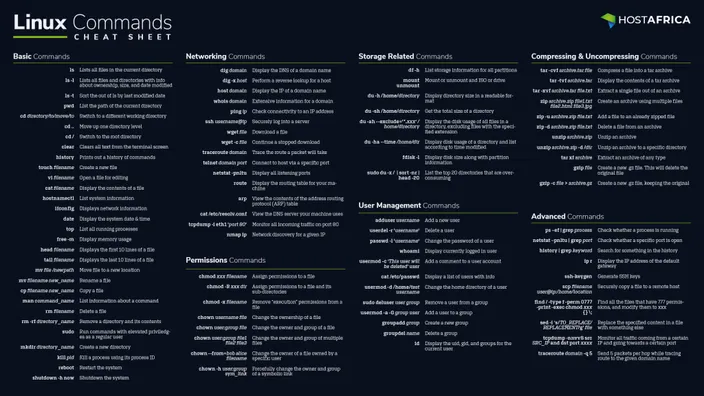
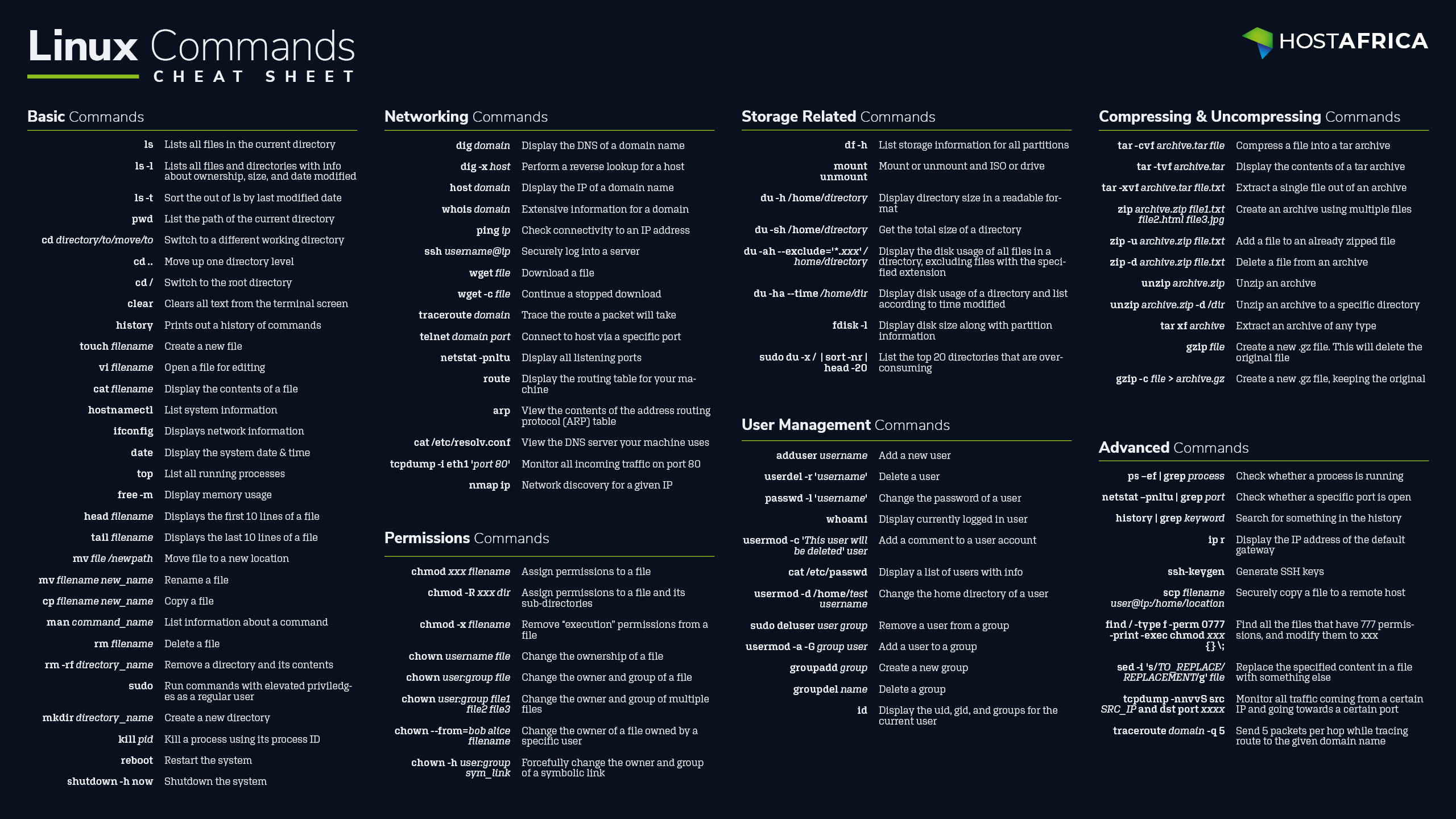
In this article, we'll be sharing 100+ such commands across different categories along with a downloadable Linux commands cheat sheet .
Basic Commands
Command
Description
Download our
Linux cheat sheet
.
Command Description
lsShow all files and directories present in the working directory
Command Description
ls -lShow all files and directories along with details like ownership, size, and when they were last modified
Command Description
ls -tSort the output of ls by last modified date
Command Description
pwdList the path of the current working directory
Command Description
cd directorySwitch to a different working directory
Command Description
cd ..Move up one directory level
Command Description
cd /Switch to the root directory
Command Description
clearWipe out all the text from the terminal screen
Command Description
historyPrint out all the previously executed commands in the current session
Command Description
touch filenameCreate a new file
Command Description
vi filenameOpen a file for editing
Command Description
cat filenameDisplay the contents of a file
Command Description
hostnamectlList system information, including kernel, release, architecture, and virtualization etc.
Command Description
ifconfigShow the network interfaces, IP addresses, and MAC address of the system
Command Description
datePrint the current system date and time
Command Description
topList all the running processes on the system
Command Description
free -mShow memory usage stats
Command Description
head filenameDisplay the first 10 lines of a file
Command Description
tail filenameDisplay the last 10 lines of a file
Command Description
mv file /new/file/pathMove the file to a different location
Command Description
mv filename new_filenameRename a file
Command Description
cp filename new_filenameCopy a file
Command Description
man command_nameList helpful information regarding a command
Command Description
rm filenameDelete a file
Command Description
rm“rf directory_nameRemove a directory and its contents
Command Description
sudoFor regular users to run commands with elevated privileges
Command Description
mkdir directory_nameCreate a new directory
Command Description
kill pidKill a process using its process ID
Command Description
rebootRestart the system
Command Description
shutdown“h nowTurn off the system
Networking Commands
Command
Description
Download our
Linux cheat sheet
.
Flexible, scalable Linux VPS hosting with full root access
Command Description
dig domain_nameShow the DNS related information of the given domain name
Command Description
dig -x hostPerform a reverse lookup for a host
Command Description
host domain_namePerform DNS lookup of the given domain name which prints out the IP address
Command Description
whois domain_nameFor more information about a domain
Command Description
ping ipCheck the connectivity between your host and the given IP address
Command Description
ssh username@ipTo securely log in as the specified user on another server
Command Description
wget fileDownload a file
Command Description
wget -c fileContinue a stopped download
Command Description
traceroute domain_nameTrace the route a packet will take when travelling from your machine to a host
Command Description
telnet domain_name portConnect to a remote host on a specific port
Command Description
netstat“pnltuDisplay all currently listening ports
Command Description
routeDisplay the routing table for your machine
Command Description
arpView the contents of the ARP (address resolution protocol) table
Command Description
cat /etc/resolv.confSee the DNS servers that your machine is currently using
Command Description
tcpdump -i eth1 'port 80'Log and monitor all incoming traffic on port 80
Command Description
nmap ipNetwork discovery of the given IP. Find out whether the host is up, which ports are open etc.
Search Commands
Command
Description
Download our
Linux cheat sheet
.
Command Description
locate keywordSearch for a file or directory in a pre-compiled cache. Much faster than find but many not show all results
Command Description
find keywordSearch for a file or directory in the real system. Much slower than locate but is always up-to-date
Command Description
find /home -name *.extSearch for the given extension in the /home directory and all its sub-directories
Command Description
find / -type f ! -perm xxxList all files that don’t have the specified permission
Command Description
find / -perm /u=rDisplay all the read-only files
Command Description
grep keyword filenameSearch for the specified keyword/pattern in the given file
Command Description
grep keyword *Search for the specified keyword/pattern across all files in the current directory
Command Description
grep -i keyword *To ignore case while searching
Command Description
grep -r keyword *Perform a recursive search, i.e. include the sub-directories in the search
Command Description
grep -x 'what to match' *Print all the lines where a match was found
Command Description
grep -c keyword *Count the number of matches
Permissions Commands
Command
Description
Download our
Linux Cheat Sheet
.
Command Description
chmod xxx filenameAssign the specified permissions to a file
Command Description
chmod“R xxx directoryAssign the specified permissions to a directory, and all its sub-directories
Command Description
chmod“x filenameRemove the execution permissions from a file
Command Description
chown username filenameChange the ownership of the specified file
Command Description
chown username:groupname filenameChange the ownership and the group ownership of a file
Command Description
chown username:groupname filename1 filename2 filename3Change the ownership and the group ownership of multiple files
Command Description
chown --from=bob alice filenameChange the ownership of a file only if it’s owned by a specific user (added after --from=)
Command Description
chown -h usergroup symbolic_linkForcefully change the owner and group of a symbolic link
Storage Commands
Command
Description
Download our
Linux Cheat Sheet
.
Command Description
df“hList storage related information of all partitions, including overall size, free space, and used space etc.
Command Description
mount
unmount
Mount or unmount an ISO file or a storage device
Command Description
du -h /home/directory_nameFind the directory size in a human readable format
Command Description
du -sh /home/directory_nameTo get the total size of a directory
Command Description
du -ah --exclude='*.xxx' /home/directory_nameDisplay the disk usage of all files in a directory, excluding files with the given extension
Command Description
du -ha --time /home/directory_nameDisplay disk usage of a directory by modification time
Command Description
fdisk -lShow disk size along with partitioning information
Command Description
sudo du -x / | sort -nr | head -20List the top 20 directories that are overconsuming resources
User Management Commands
Command
Description
Download our
Linux cheat sheet
.
Command Description
adduser usernameAdd a new user
Command Description
userdel -r 'username'Delete a user
Command Description
passwd -l 'username'Change the password of a user
Command Description
whoamiSee the currently logged in user
Command Description
usermod -c 'This user will be deleted tomorrow' usernameTo add a comment to a user account
Command Description
cat /etc/passwdDisplay a list of all users with additional info
Command Description
usermod -d /home/test usernameChange the home directory of a user
Command Description
sudo deluser username group_nameRemove a user from a group
Command Description
usermod -a -G group_name usernameAdd a user to a group
Command Description
groupadd group_nameCreate a new group
Command Description
groupdel group_nameDelete a group
Command Description
idDisplay the user ID, group ID, and groups for the current user
Archive Commands
Command
Description
Download our
Linux cheat sheet
.
Command Description
tar -cvf archive.tar filename.txtCompress a file into a tar archive
Command Description
tar -tvf archive.tarDisplay the contents of a tar archive
Command Description
tar -xvf archive.tar filename.txtExtract a single file out of a tar archive
Command Description
zip archive.zip file1.txt file2.html file3.jpgCreate a zip archive using multiple files
Command Description
zip -u archive.zip filename.txtAdd a file to an already zipped file
Command Description
zip -d archive.zip filename.txtDelete a file from a zip archive
Command Description
unzip archive.zipUnzip a zip archive
Command Description
unzip archive.zip -d /directory_nameUnzip a zip archive to a specific directory
Command Description
tar xf archiveExtract archive of any type
Command Description
gzip filenameCompress a file and add the .gz extension to it. This will delete the original file
Command Description
gzip -c filename > archive.gzCreate a new compressed .gz file, preserving the original
Advanced Commands
Command
Description
Download our
Linux cheat sheet
.
Command Description
ps“ef | grep process_nameCheck whether a specific process is running
Command Description
netstat“pnltu | grep portCheck whether a specific port is open
Command Description
history | grep keywordSearch for something in the history
Command Description
ip rDisplay the IP address of the default gateway
Command Description
ssh-keygenGenerate SSH keys to allow public key based secure login
Command Description
scp filename user@ip:/home/locationSecurely copy a file to a remote host
Command Description
find / -type f -perm 777 -print -exec chmod xxx {} \;Find all the files that have 777 permissions, and modify them to xxx
Command Description
sed -i 's/CONTENT_TO_REPLACE/CONTENT_TO_REPLACE_IT_WITH/g' filenameReplace the specified content in a file with something else
Command Description
tcpdump -nnvvS src SRC_IP and dst port xxxxMonitor all traffic emerging from a certain IP and going towards a certain port
Command Description
traceroute domain_name -q 5Send 5 packets per hop while tracing the route to the given domain name
Downloadable Linux Commands Cheat Sheet
Download the 2560x1440 wallpaper Linux cheat sheet for easy reference.
Download the Cheat Sheet
If you found this Linux commands cheat sheet useful, these related beginner guides can help you practise file navigation, log reading, grep, and other everyday command-line tasks: