Guest Post Contributed by Bold Online
When businesses invest in SEO, the focus usually falls on keywords, content, backlinks and technical optimisation. But there’s a couple of considerations that form part of the equation that’s often overlooked: where and how the website is hosted.
Your hosting provider doesn’t determine whether your website ranks on Google. However, the hosting environment can have a meaningful impact on the technical foundations that support SEO. This includes server response times, page speed, Core Web Vitals, crawl efficiency, and website availability.
For South African businesses, hosting choices can be particularly important. If most of your customers are accessing your website from South Africa, the location and infrastructure supporting your website can influence how quickly it responds to those visitors. HostAfrica’s South African hosting infrastructure is one practical example of how businesses can choose an environment that is geographically relevant to a primarily local audience, without treating server location itself as a Google ranking advantage.
So, does hosting affect SEO?
Indirectly, yes.
The relationship becomes clearer when you look at three key areas: speed, reliability and server location.
Why Hosting Matters for SEO
Google uses many signals when determining which pages appear in search results. Core Web Vitals are part of Google’s page experience and ranking systems, but they’re not a standalone ranking factor, and achieving “good” Core Web Vitals doesn’t guarantee higher rankings.
Where hosting becomes important is in the technical environment underneath your website.
A poorly performing server can create delays before a website even begins loading. It can also struggle when traffic increases, or when search-engine crawlers request multiple pages.
How Hosting Can Affect Crawlability
Google’s crawlers need to be able to access your website consistently. When a server becomes slow or repeatedly returns server errors, Google can reduce its crawling activity.
Persistent 5xx server errors can be particularly problematic. If Googlebot repeatedly encounters server-side problems, crawling can slow down. In prolonged cases, affected URLs can eventually be removed from Google’s index.
This means hosting isn’t an SEO strategy by itself, but it can either support or hinder the technical environment in which your SEO strategy operates.
What Are Core Web Vitals?
Core Web Vitals measure three important aspects of the real-world user experience:
- LCP (Largest Contentful Paint): How quickly the main content becomes visible.
- INP (Interaction to Next Paint): How quickly a page responds to user interactions.
- CLS (Cumulative Layout Shift): How stable the page remains while loading.
Hosting can have its strongest influence on the loading side of the equation, particularly through server response time and caching.
Server Speed and Time to First Byte (TTFB)
One of the most useful measurements when investigating hosting performance is Time to First Byte, or TTFB.
TTFB measures the time between a visitor making a request and receiving the first byte of the server’s response.
Think of it as the time between knocking on a door and someone answering.
If the server takes longer to respond, everything that follows is delayed.
This is particularly relevant to Largest Contentful Paint (LCP), which measures how quickly the largest visible element on a page becomes available to the visitor.
Google currently considers an LCP of 2.5 seconds or less to be good when measured at the 75th percentile of real-world visits.
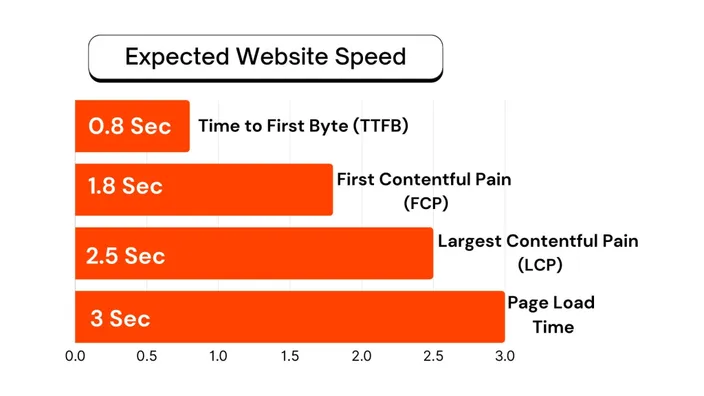
Image: TTFB and LCP diagram
What Affects TTFB?
Several hosting and infrastructure factors can influence TTFB, including:
- Server CPU and memory resources
- PHP processing
- Database performance
- Server-side caching
- Object caching and OPcache
- Storage technology
- Network infrastructure
- Server load
- Resource contention on shared hosting
- Traffic spikes
A website hosted on an overloaded server may experience slower response times even when the website’s own code has been properly optimised.
Modern infrastructure, efficient caching, and appropriately allocated resources can therefore remove some of the bottlenecks that sit underneath website speed. For websites where speed and caching are a priority, HostAfrica’s LiteSpeed Hosting provides a performance-focused hosting option that can support this technical foundation. It shouldn’t be viewed as a guarantee of better SEO performance, but as one way of providing the server environment, caching capabilities, and resources that website optimisation can build on.
Why TTFB Matters for LCP
LCP doesn’t happen in isolation.
Before the browser can display the main content, it needs to receive and process the resources required to render it. A slow server response can therefore consume part of the time available for the rest of the loading process.
This is why website optimisation shouldn’t stop at compressing images or minifying code.
If the underlying server is slow, there’s a limit to how much front-end optimisation can compensate for it.
The takeaway: TTFB isn’t a direct Google ranking threshold, but improving server response time can give your website a stronger foundation for achieving good page-speed performance and Core Web Vitals.
Uptime and Reliability: The Crawlability Connection
A website can’t serve customers or search engines when it’s unavailable.
Temporary downtime doesn’t automatically mean a website will lose its rankings. Google is designed to deal with temporary technical problems.
However, persistent availability problems are a different matter.
When Googlebot encounters 5xx server errors or repeated failures, Google can temporarily slow its crawling. If those problems continue, URLs can eventually be removed from Google’s index.
Why Uptime Matters Beyond SEO
The consequences of downtime aren’t limited to search engines.
If your website is unavailable:
- Customers can’t browse your products or services.
- Online enquiries may be lost.
- Ecommerce transactions can’t take place.
- Paid advertising traffic may land on an unavailable website.
- Brand trust can be affected.
This is why uptime and SEO shouldn’t be treated as completely separate conversations.
When evaluating a hosting provider, look beyond the headline price and consider:
- Uptime commitments and SLA
- Server monitoring
- Backup and recovery systems
- Infrastructure redundancy
- Resource allocation
- Support response times
- Scalability during traffic spikes
- Transparency around server status
A 99.9% uptime SLA is a useful baseline, although businesses with revenue-critical websites may want to look for even stronger availability.
For general business websites, HostAfrica Web Hosting provides a practical starting point when considering a reliable hosting environment, with options aimed at the South African market and free SSL included. As with any hosting decision, the appropriate plan should still be matched to the website’s traffic, platform, and resource requirements.
Does Server Location Affect SEO?
Server location is often misunderstood.
Having a server physically closer to your customers can reduce network latency, which can contribute to faster response times.
If your primary audience is in South Africa, hosting your website on infrastructure in South Africa can therefore be a sensible performance decision. HostAfrica’s local South African infrastructure provides a practical example of this: businesses serving a predominantly South African audience can choose hosting infrastructure closer to those users to help reduce baseline network latency.
However, this shouldn’t be interpreted as:
“A South African server automatically gives you higher Google rankings in South Africa.”
That isn’t how local SEO works.
Server Location and Website Performance
The benefit comes primarily through performance.
The further data has to travel between your hosting infrastructure and your visitor, the more network latency can potentially be introduced.
For a predominantly South African audience, local infrastructure can help reduce this baseline latency.
This can be particularly relevant for dynamic requests that can’t simply be delivered from a CDN cache.
What About a CDN?
A Content Delivery Network (CDN) can significantly reduce the importance of physical server location for cached and static content.
A CDN stores copies of certain website resources at locations closer to visitors, allowing those resources to be delivered from a nearby edge server rather than travelling all the way back to the origin server.
For businesses serving international audiences, a combination of appropriately located hosting and CDN infrastructure may therefore be more effective than relying on server location alone.
For businesses primarily serving South African customers, local hosting infrastructure can still provide a strong baseline, particularly for dynamic content and server-generated responses.
Core Web Vitals Explained in Hosting Terms
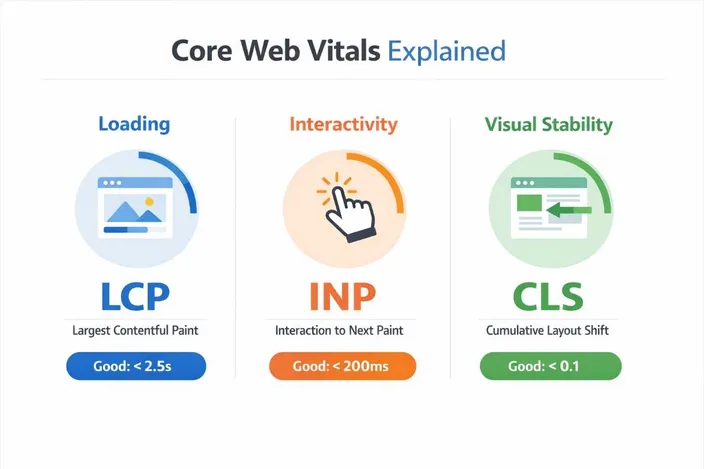
Core Web Vitals are designed to measure real-world aspects of website experience.
The three current metrics are LCP, INP and CLS.
| Metric | What it measures | Good threshold | Where hosting can help |
| LCP | How quickly the main content becomes visible | ≤ 2.5 seconds | Server response time, caching, infrastructure and network performance |
| INP | How quickly the page responds to user interactions | < 200ms | Server-side processing can matter in some architectures, but JavaScript execution and browser-side performance are usually more significant |
| CLS | How much visible content unexpectedly moves | < 0.1 | Primarily website implementation, image dimensions, and front-end behaviour rather than hosting |
LCP: Largest Contentful Paint
LCP measures how quickly the largest visible piece of content becomes available.
This is where hosting has one of its clearest relationships with Core Web Vitals.
Slow server response times can delay the resources required to render the main content.
Caching, efficient infrastructure, and good server response times can therefore provide a stronger foundation for LCP optimisation. A performance-focused environment such as HostAfrica’s LiteSpeed Hosting can be relevant here because it brings the hosting and caching layer into the wider optimisation picture, while the website itself still needs to be properly optimised.
INP: Interaction to Next Paint
INP measures how quickly a page responds when a visitor interacts with it.
It’s important not to treat INP as simply a server-speed metric.
Heavy JavaScript, long browser tasks, and inefficient front-end code are often much more significant contributors to poor INP.
However, server-side processing can still matter for interactions that depend on requests to the server.
CLS: Cumulative Layout Shift
CLS measures how much visible content unexpectedly moves while a page loads.
A website can have excellent hosting and still have a poor CLS score.
For example, images without defined dimensions, dynamically injected content or advertising elements can cause a page to shift as it loads.
CLS is therefore primarily a website implementation issue rather than a hosting issue.
The important point is that hosting isn’t the solution to every Core Web Vitals problem.
The best results come from looking at the entire performance stack: hosting, caching, code, images, JavaScript, CSS, and the browser experience.
What to Look For in SEO-Friendly Hosting
If website performance and SEO are important to your business, consider these points when comparing hosting providers.
1. Server Location
Choose infrastructure that makes sense for your primary audience.
For South African businesses, local infrastructure can help minimise baseline network latency. HostAfrica offers several hosting environments for different website requirements, from general Web Hosting and WordPress Hosting through to Cloud VPS and Dedicated Servers, so the goal is to choose the option that fits the website rather than simply choosing the most powerful plan.
2. Reliable Uptime
Look for a clearly stated uptime commitment and understand what the SLA actually covers.
3. Modern Storage
SSD and NVMe storage can improve performance for storage-intensive operations compared with older storage technologies.
4. Effective Caching
Caching can reduce the amount of processing required to generate the same pages repeatedly.
Depending on your website and hosting environment, this can include page caching, object caching, OPcache, and CDN caching. For businesses specifically prioritising website speed and caching, HostAfrica’s LiteSpeed Hosting is one performance-focused option to consider as part of the wider technical stack.
5. Scalable Resources
A website that performs well under normal traffic but struggles during a traffic spike isn’t genuinely resilient.
Scalable resources can help prevent traffic increases from turning into performance problems, particularly during successful SEO campaigns, product launches, or promotional periods. When a website has outgrown conventional shared hosting or needs greater control over its resources, HostAfrica Cloud VPS provides dedicated resources and greater control for more demanding websites and applications. For high-traffic, resource-intensive or business-critical environments, Dedicated Servers can provide the next level of dedicated infrastructure and control.
6. SSL and Modern Protocols
HTTPS is essential for modern websites. HostAfrica’s Web Hosting plans include free SSL, removing one practical barrier to serving a website securely over HTTPS. HTTP/2 and HTTP/3 can also support more efficient delivery depending on the hosting environment, browser, and website configuration.
7. Responsive Technical Support
When something goes wrong, response time matters.
A hosting provider that can quickly identify and resolve infrastructure problems can help limit the SEO and commercial consequences of downtime.
Choosing Hosting That Fits Your Website
The appropriate hosting environment also depends on the platform and demands of the website itself. For example, businesses running WordPress can consider HostAfrica WordPress Hosting as a hosting option designed around that platform. General business websites may be well suited to Web Hosting, while websites with heavier workloads, growing traffic or more specialised infrastructure requirements may need a Cloud VPS or Dedicated Server. Matching the hosting environment to the website’s actual requirements helps avoid both resource constraints and unnecessary complexity.
Hosting Is the Foundation. SEO Builds on It.
A fast, reliable hosting environment won’t automatically move a website from page 10 to page one.
SEO is much bigger than hosting.
Technical SEO, keyword research, search intent, content quality, internal linking, backlinks, structured data, local SEO, and conversion optimisation all contribute to building organic visibility.
But, those strategies work better when the technical foundation isn’t working against them.
At Bold Online, we look at SEO as a complete system rather than a collection of isolated tasks. Technical SEO is one part of our approach, alongside content, on-page optimisation, authority building and broader search strategy.
If your business needs help building a stronger organic search presence, you can learn more about Bold Online, an SEO company in South Africa.
Why the Right Hosting Foundation Matters
In short, hosting is one part of the technical foundation that supports a successful SEO strategy. Fast server response times, reliable uptime, and infrastructure suited to your audience can help create a better experience for both users and search engines.
Combined with strong content, technical SEO, relevant backlinks and ongoing optimisation, the right hosting environment gives your website a stronger platform from which to grow.
For businesses evaluating that foundation, HostAfrica’s range spans general Web Hosting, performance-focused LiteSpeed Hosting, WordPress-specific hosting, Cloud VPS and Dedicated Servers, allowing the hosting environment to evolve as the website’s requirements change.
Conclusion: Your Hosting Choice Matters More Than You Think
Hosting isn’t an SEO strategy, but it is part of the infrastructure that allows an SEO strategy to perform.
Speed, uptime, and server location can all influence the technical experience of accessing your website. In turn, these factors can affect page performance, Core Web Vitals, crawl efficiency, and website availability.
For South African businesses, choosing hosting with the right combination of performance, reliability, infrastructure, and location is therefore a worthwhile technical consideration. That may mean starting with reliable Web Hosting, choosing a performance-focused LiteSpeed environment, using WordPress Hosting for a WordPress site, or moving to Cloud VPS or Dedicated server infrastructure as traffic and resource requirements grow.
The goal isn’t to chase a perfect PageSpeed score. It’s to build a website that’s fast enough, reliable enough, and technically sound enough to give your SEO strategy the best possible foundation.
When your hosting environment supports your website rather than holding it back, your SEO strategy has a stronger foundation on which to build.
Find the Right Hosting for Your Website
The right hosting environment can make a meaningful difference to your website’s speed, reliability and overall performance. Whether you’re looking for dependable web hosting, faster LiteSpeed hosting or a solution that can grow with your business, HostAfrica offers a range of hosting options designed for different website needs.
See HostAfrica’s hosting solutions and compare your options to find the right fit for your website.
Frequently Asked Questions About Hosting and SEO
Does hosting affect SEO directly?
Hosting isn’t a standalone ranking factor that determines where a website appears in Google. However, hosting can affect technical factors such as server response time, website availability and page performance, which can influence the experience of users and search-engine crawlers.
What is a good TTFB for SEO?
There isn’t a Google ranking threshold for TTFB. Faster server response times generally give a website a stronger performance foundation, particularly when optimising loading metrics such as LCP.
What uptime should I look for in a hosting provider?
A 99.9% uptime SLA is a useful baseline when comparing hosting providers. Businesses that rely heavily on their website for leads or ecommerce should also consider infrastructure redundancy, monitoring, support response times, and scalability.
Does server location affect Google rankings?
Server location isn’t a direct local SEO ranking factor. However, hosting closer to your primary audience can reduce network latency and potentially improve performance, particularly for dynamic content. A CDN can also reduce the importance of physical server distance for cached content.
Can good hosting fix poor Core Web Vitals?
Not by itself. Hosting can contribute to performance, particularly server response time and caching, but Core Web Vitals are also affected by images, JavaScript, CSS, page structure, and other front-end factors.